Rethinking Flocculation Scale-Up: The Average Shear Rate Fallacy
Oral presentation5. Single-phase and multiphase mixing: laminar and turbulent regimes08:55 AM - 10:15 AM (Europe/Dublin) 2026/09/01 07:55:00 UTC - 2026/09/01 09:15:00 UTC
Secondary settling tanks (SSTs) serve as the final stage of wastewater treatment. These units rely heavily on chemically induced aggregation to remove fine impurities, but frequently suffer from off-spec effluent quality. Although extensive laboratory testing is conducted to evaluate chemical performance and understand aggregation mechanisms (coagulation and flocculation), laboratory results often show poor correlation to full-scale behavior. This disconnect stems from a lack of physically meaningful scale-up/down parameters, with industry typically selecting average shear rates (G-value) to mimic full-scale conditions in laboratory tests – with limited predictive success. The purpose of this study is to evaluate the hydrodynamic scaling parameters governing flocculation in three bench-scale mixing vessels: two geometrically similar baffled cylindrical tanks (T = 0.139 m and 0.243 m) and one square tank (T = 0.139 m), equipped with a T/3 Rushton turbine. A high molecular weight polyacrylamide flocculant was used to induce bridging flocculation in dilute slurries (Cv < 1%) of 2 μm particles. Experiments were performed for average shear rates of 30–100 s⁻¹ (0.001–0.01 W/kg). Maximum local energy dissipation was estimated for each condition using M-Star CFD simulations. In the experiments, floc size evolution was measured in-line using a SOPAT probe (9–1200μm). Trends in Sauter mean diameter (D32) show that the frequency of floc passages through the impeller discharge region strongly impacts floc evolution and steady-state size. The findings demonstrate the importance of replicating local energy dissipation from key mixing zones across scales, providing a framework for designing physically meaningful lab-tests for full-scale SSTs.
Presenters Sahil Sood University Of Alberta Co-Authors
HYDRODYNAMIC OPTIMIZATION OF AN IMPELLER - THE EPAL 3
Oral presentation8. Reactive mixing, crystallisation, dissolution, precipitation08:55 AM - 10:15 AM (Europe/Dublin) 2026/09/01 07:55:00 UTC - 2026/09/01 09:15:00 UTC
In high pressure acid leaching (HPAL) autoclaves employed in the mineral processing industry, agitators play a critical role in ensuring rapid and homogeneous mixing of the ore slurry with sulfuric acid. This prevents localized acid concentration gradients and supports high leaching kinetics. Additionally, effective agitation maintains solid particles in suspension, enabling reliable slurry transport between compartments. Despite advanced designs such as the state of the art EPAL impeller, deposit formation on impellers and autoclave walls remains a persistent operational challenge. To address this, a novel energy efficient impeller, the EPAL 3, with a specifically engineered geometry has been developed to reduce scaling. The design was optimized using advanced numerical simulations and laboratory testing, validated across multiple scales, and is now ready for industrial scale deployment.
Presenters Wolfgang Keller Head Of R&D, EKATO RMT Co-Authors
Progress on Measuring the Yield Stress of Non-Newtonian Slurries with Coarse Particles Using an Instrumented Mixing Setup
Oral presentation4. Handling complex fluids (non-Newtonian, viscoelastic, emulsions, suspensions)08:55 AM - 10:15 AM (Europe/Dublin) 2026/09/01 07:55:00 UTC - 2026/09/01 09:15:00 UTC
In slurry transport pipelines, determining the laminar-turbulent transition velocity for an industrial slurry with a yield stress is important as it can significantly impact flow behaviour and the ability to transport solids in a pipeline. The laminar-turbulent transition velocity is directly dependent on the Bingham (or fully- sheared) yield stress of the slurry being transported. It has also been observed that the presence of coarse particles can significantly increase the yield stress of a slurry, a phenomenon dubbed yield stress augmentation. The gap in a concentric cylinder viscometer is typically much too small to accurately measure the rheology of an industrial coarse particle slurry as the particles interfere with the walls of the geometry. While we can measure the yield stress augmentation using a vane viscometer, we currently do not have an efficient and reliable method to measure the fully-sheared yield stress of a slurry that can capture the coarse particle augmentation effect. However, it has been shown from Elson et al. (1986) and other works that rotating, open impellers in yield stress fluids form caverns that will vary in diameter with the fluid yield stress, alongside other parameters. So, for a given impeller, tank geometry and impeller rotation speed, the yield stress of the fluid could be determined by measuring the cavern diameter. This work will present the development progress of an instrumented mixing setup that aims to use cavern sizes to determine the fully-sheared (Bingham) yield stress of industrial slurries with coarse particles.
DEM Simulations of the dry mixing of NMC 622 lithium-ion battery cathodes
Oral presentation12. Mixing in energy systems (hydrogen carriers, battery fluids, CCUS)08:55 AM - 10:15 AM (Europe/Dublin) 2026/09/01 07:55:00 UTC - 2026/09/01 09:15:00 UTC
Understanding of dry mixing in the manufacturing of lithium-ion battery electrodes has the potential to improve process sustainability by either reduction or elimination of organic solvents and consequent energy costs of slurry drying. The dry mixing dynamics of NMC 622, a cathode electrode material used in lithium-ion batteries, were simulated using the Discrete Element Method (DEM), with the simulations calibrated from the material properties of NMC 622. These simulations were then validated using experimental Positron Emission Particle Tracking (PEPT) data across a range of rotor tip-speeds at a fixed co-rotating pan speed and fill height. Both methods captured a disengagement of the free surface of the electrode material from the rotor at higher tip-speeds, and diminishing mixing performance, confirmed by estimating the transient mixing time using the Lacey mixing index. The DEM simulations were used to explore the granular dynamics of NMC 622 at different fill heights. Fill height was adjusted by adding more particles into the mixer up to 2.5 times the initial number of particles. It was found that this increased the volume of the granular fluid around the rotor and lowered the number of particles in the granular gas above, as less are thrown clear of the main material flow by the rotor. Particle velocities, changes in vessel circulation time, dispersion and Péclet number were calculated. These gave an understanding of the dominant mixing mechanism and vessel turnover; the Lacey mixing index was calculated to compare transient mixing times and particle dynamics in the granular fluid.
 Sahil Sood
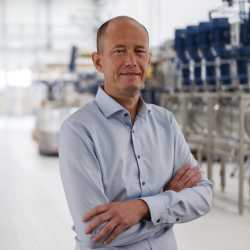 Wolfgang Keller